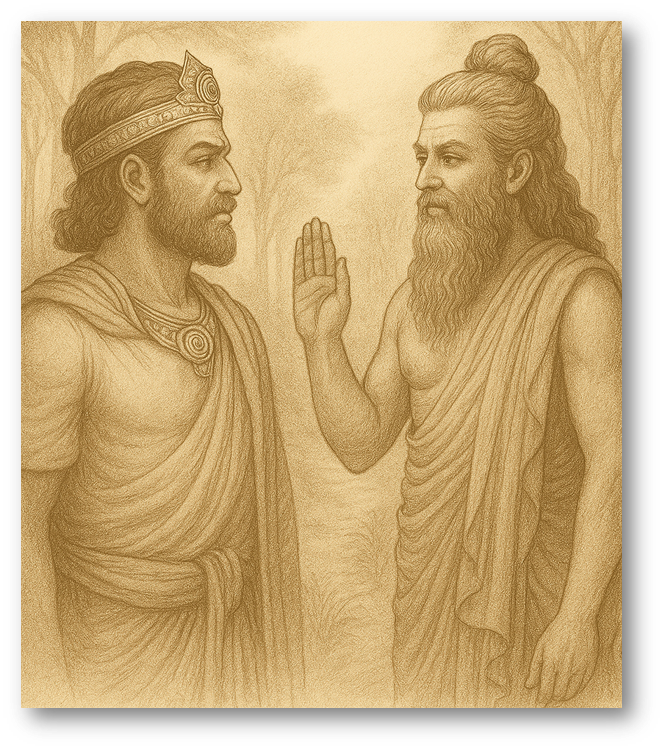
Chapter 1: The Proud King Kaushika
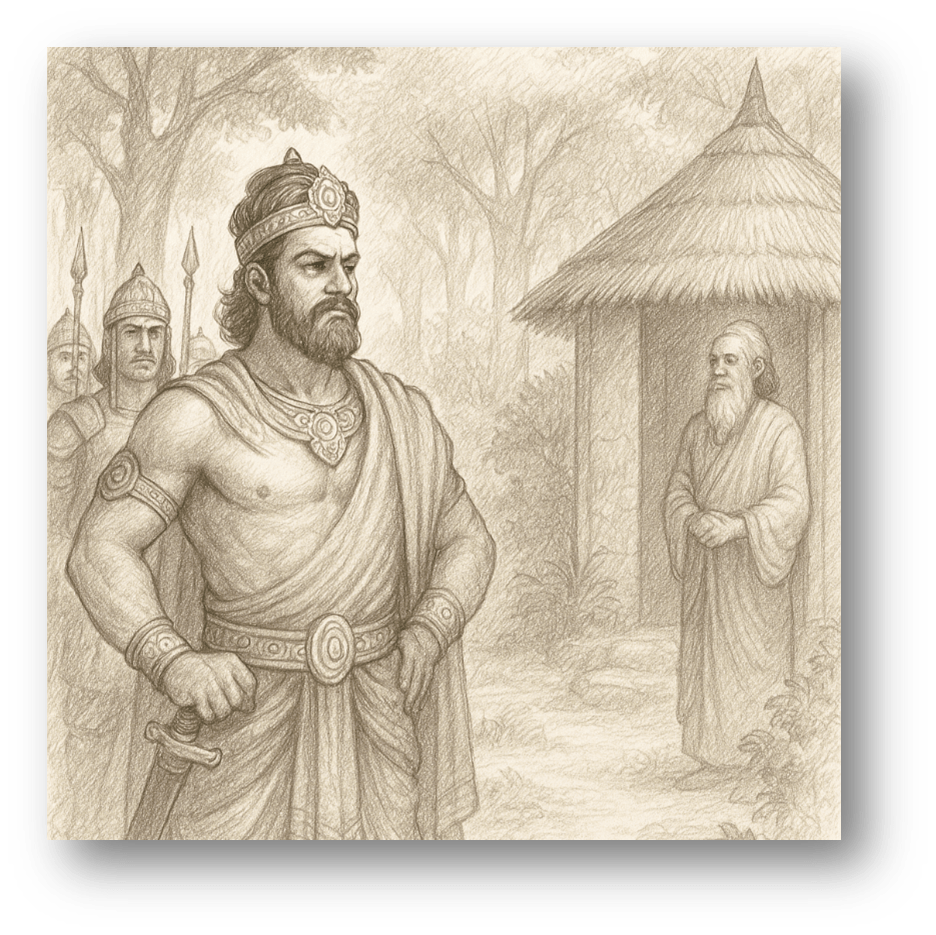
In the ancient kingdom of Kanyakubja, there ruled a mighty monarch named Kaushika. He was tall, broad-shouldered, and carried himself with the pride of countless victories. His sword was feared across neighbouring lands, and his armies obeyed his word without question. To Kaushika, there was no power greater than the might of a king.
One day, while hunting in the forest, Kaushika and his retinue stumbled upon the quiet hermitage of the sage Vashishta. The air there was different—calm, serene, untouched by the noise of kingdoms and wars. The sage came forward with folded hands and a gentle smile, welcoming the king and his warriors as honoured guests.
Kaushika was curious. How could a hermit, with nothing but a simple hut and staff, offer hospitality to an entire army? Yet Vashishta did so with ease. Soon, Kaushika and his men were feasting as though in the halls of a palace, the food and drink appearing in endless supply.
The source of this miracle was revealed: Nandini, the divine cow, daughter of Kamadhenu. She could grant anything her master desired.
Kaushika’s eyes gleamed with desire.
Such a treasure is wasted in a hermitage. Give her to me, O Sage,” he demanded.
With her, I can feed my armies and expand my kingdom without limit.”
But Vashishta shook his head.
“She is not mine to give. Nandini belongs to this ashram, and here she shall stay.”
The refusal stung Kaushika’s pride. No one denied a king. And thus began the rivalry that would change the course of Kaushika’s life forever.
Chapter 2: The Humiliation at Vashishta’s Ashram
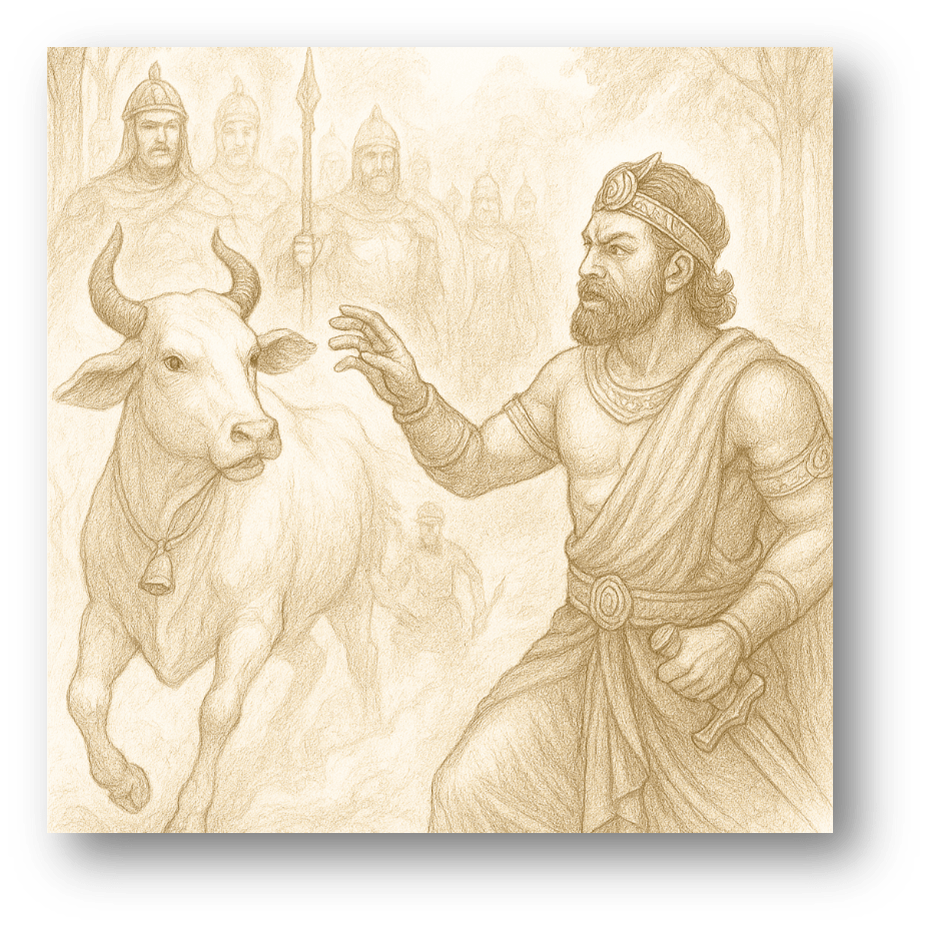
Kaushika’s desire for Nandini grew fierce. He stepped forward, his voice commanding,
“This cow is not fit for a hermit’s hut. She belongs in the royal stables of a king. Give her to me, Vashishta.”
But the sage stood calm and immovable. “She is not mine to give. Nandini belongs to this ashram. Her purpose is to serve dharma, not ambition.”
Kaushika’s pride boiled into anger. He ordered his soldiers to seize the cow. But Nandini, sensing her master’s distress, stamped her hooves and let out a cry that echoed across the heavens. From her breath, her tail, her body, there sprang forth a vast army of phantom warriors, armed and fierce, thundering upon Kaushika’s men.
The clash was swift. Kaushika’s proud soldiers, though seasoned in war, fell like dry leaves before the storm. The king himself stood helpless, forced to watch his mighty force crumble before the will of a cow and the calm strength of a sage.
Defeated, humiliated, and stripped of his pride, Kaushika left the ashram with his head bowed. That day he realized that spiritual power was greater than worldly might.
Chapter 3: The King Becomes an Ascetic
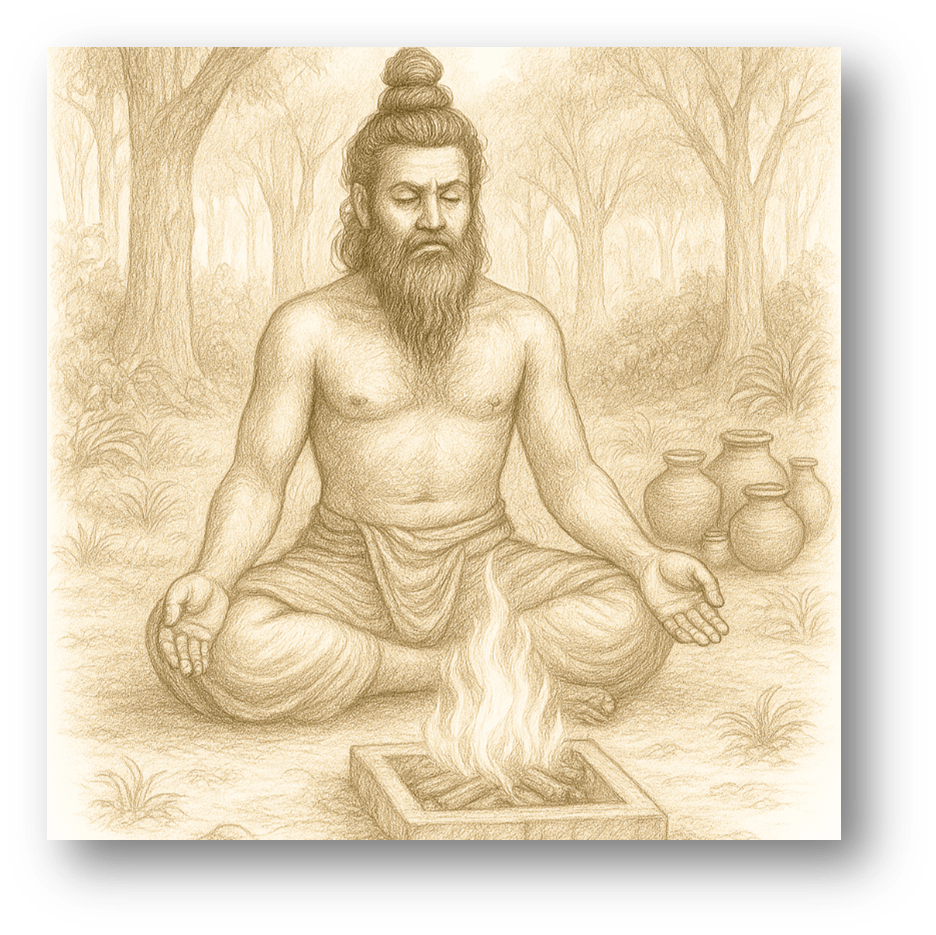
Defeat at Vashishta’s ashram haunted Kaushika’s heart. The echo of phantom warriors and the calm refusal of the sage burned deeper than any wound from battle. What worth was a crown if it could be humbled by a hermit’s cow?
One night, seated in his palace, Kaushika gazed at the jewelled crown resting on his throne. Its weight felt heavy, not with power, but with emptiness. He removed it, along with his sword, and laid them aside.
“This throne binds me,” he thought, “but wisdom can free me.”
Resolute, he stepped out of his palace in the garb of a seeker, clad in simple robes, his only possession a staff. With each step away from the grandeur of his court, he walked closer to his true destiny.
From that day, Kaushika was no longer a king. He became Vishvamitra…Friend of the Universe—an ascetic whose fire of Tapasya (penance) would shake the heavens themselves.
Chapter 4: Menaka and Shakuntala
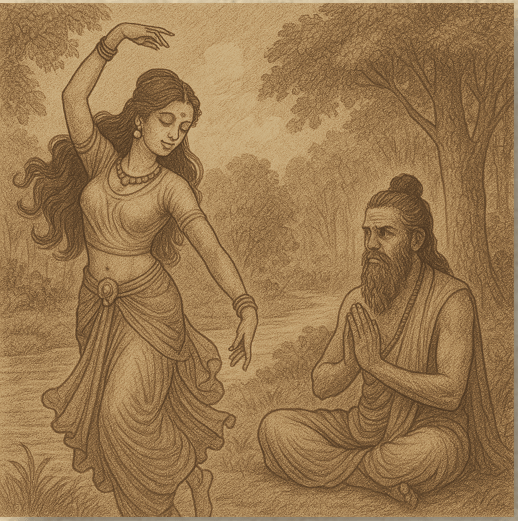
As the years passed, Vishvamitra’s penance blazed like fire. The gods grew uneasy. His power, born from silence and discipline, threatened even the heavens. Indra, king of the gods, resolved to break his meditation.
He summoned the celestial dancer Menaka, the most graceful among the apsaras.
“Distract him,” Indra commanded.
“Draw him away from his penance.”
Menaka descended to the forest where Vishvamitra meditated beneath ancient trees. The river rippled nearby, catching the glimmer of dawn. She danced with elegance, her anklets chiming, her beauty radiant as moonlight.
Vishvamitra opened his eyes. For a moment, his still heart stirred. Desire, long buried, rose like a tide. Menaka’s laughter was soft, her eyes inviting. The sage, though mighty in resolve, faltered. He lived with her, and from their union was born a daughter Shakuntala, destined to
be the mother of Bharata, after whom the land of India would one day be named.
But when Vishvamitra realized that his penance had been broken by design, sorrow and shame consumed him. His love for Menaka faded like mist. With iron will, he left her behind and returned to his path of austerity, fiercer than before.
Chapter 5: Wonders of Vishvamitra
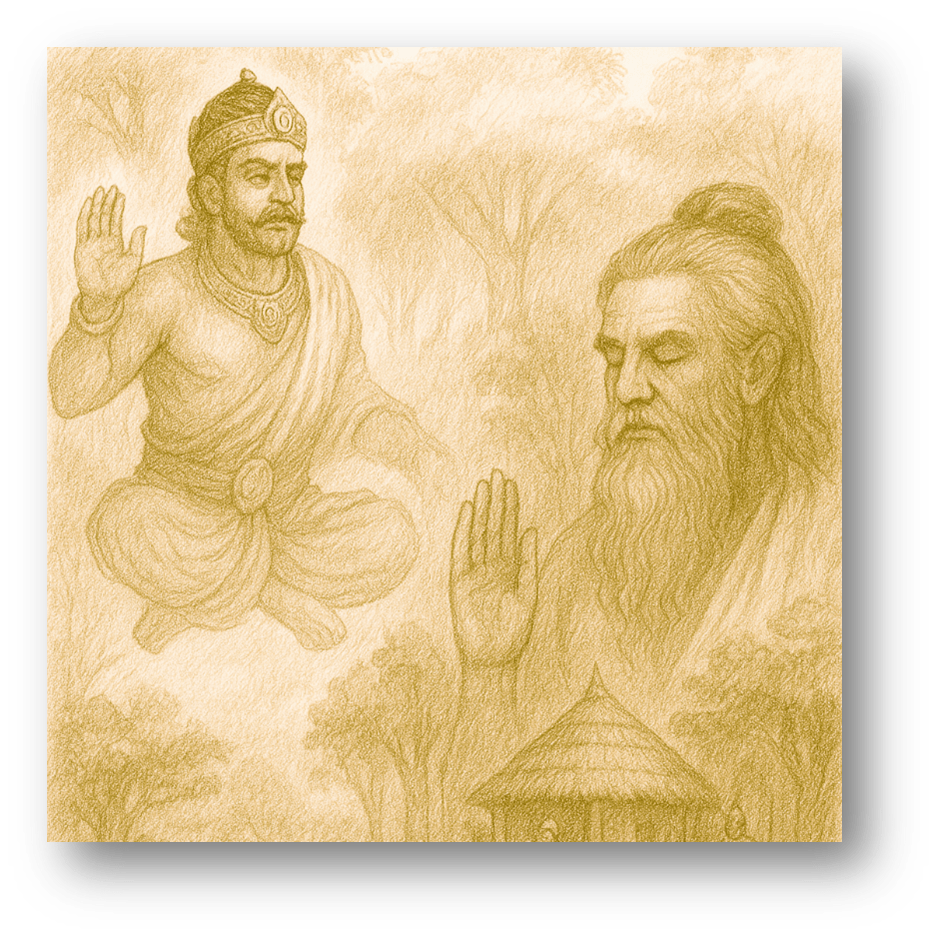
Vishvamitra’s Tapasya deepened until even the gods trembled. His power, born from silence and sacrifice, rippled through the worlds. The once-proud king had become a sage whose could command the elements themselves.
When King Trishanku sought to ascend to heaven in his mortal body, the gods denied him. But Vishvamitra, moved by his plea, raised his hands in fiery determination. With sheer force of will, he created a new heaven, placing
Trishanku there forever suspended between earth and sky. The gods themselves watched in awe and fear.
It was also Vishvamitra who revealed the sacred Gayatri Mantra, a hymn to the Sun, destined to guide seekers of truth for millennia. Its syllables carried the radiance of divine light, a gift from the sage’s penance to humanity.
His meditation also brought him mastery over celestial weapons. Agni’s flames, Indra’s thunderbolt, Varuna’s waters all obeyed his command. Vishvamitra was no longer merely a man; he was a sage whose power rivalled the gods themselves.
Yet, for all his greatness, one thing still eluded him: the recognition of Brahmarishi, the highest title of a sage. And for that, he would need to conquer not heaven, nor earth but his own pride.
Chapter 6: The Final Test
Despite his great powers and wondrous deeds, Vishvamitra’s heart still yearned for one thing…the title of Brahmarishi, a recognition only Sage Vashishta could bestow. Yet his pride and temper kept him from attaining it.
Years passed into centuries. Vishvamitra’s hair grew white, his body frail, but his will never wavered. He faced trials of anger, humiliation, and temptation, each one stripping away his arrogance. At last, his spirit was no longer bound by ego.
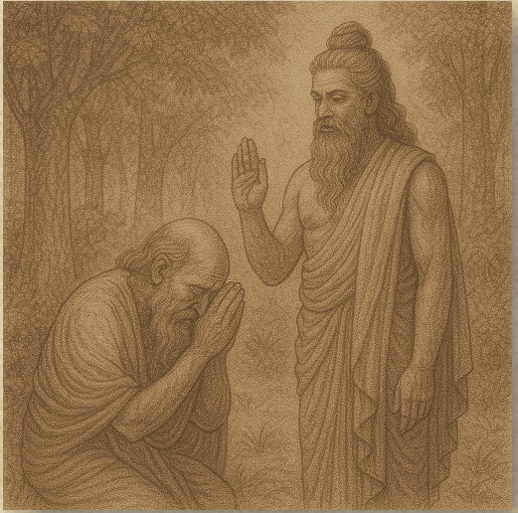
One day, he came before Vashishta…not as a rival, not as a king, but as a humble seeker. Bowing low, he placed his forehead upon the ground. His voice trembled:
“I am but dust at your feet. Bless me, O Sage.”
Vashishta’s eyes softened. He saw not the proud king who once demanded Nandini, nor the fiery ascetic who shook the heavens, but a soul purified through struggle. Lifting his hand in blessing, Vashishta declared:
“You are no longer Kaushika, no longer merely Vishvamitra. Today, you are a Brahmarishi.”
In that moment, the forest filled with divine light. The heavens rejoiced. The warrior-king who once sought to conquer the world had finally conquered himself.
Chapter 7: Teacher of Princes
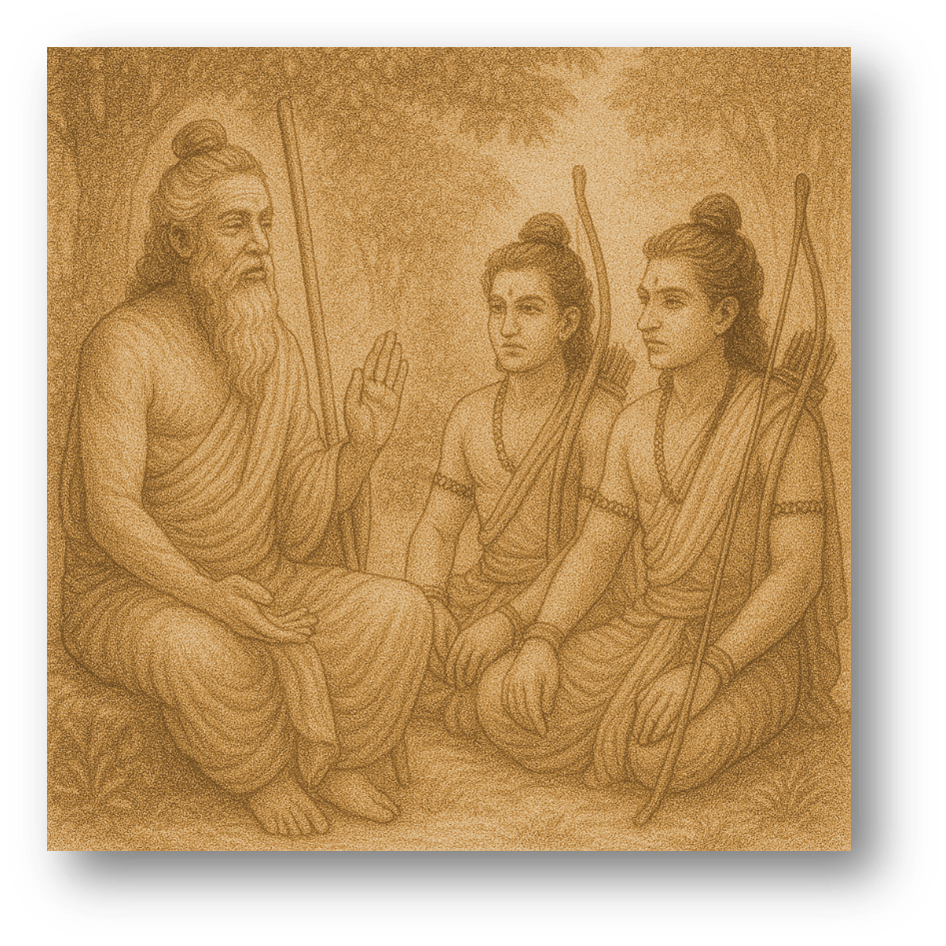
When at last he was recognized as a Brahmarishi, Vishvamitra turned his strength to guiding the next generation. His role was no longer to conquer, but to teach.
At the court of King Dasharatha of Ayodhya, Vishvamitra requested that the young princes Rama and Lakshmana accompany him to the forest. The king hesitated, fearing for their safety, but the sage assured him:
“In their youth lies great destiny. I will guide them, and they shall protect dharma.”
In the forest, Vishvamitra became their mentor. He taught them the secrets of divine weapons—the mantras that could summon arrows of fire, water, wind, and light. Under his guidance, Rama and Lakshmana grew into warriors whose strength was tempered with wisdom.
It was during these journeys that Rama first faced and defeated the demons who threatened Vedic rituals, laying the foundation for his greater battles ahead. Through Vishvamitra’s training, the princes learned not only the art of war but also the path of righteousness.
Thus, the sage who began as a king seeking power ended his journey as a teacher, shaping the future of an empire and preparing the guardians of dharma.

 மையின் சாரல்கள்