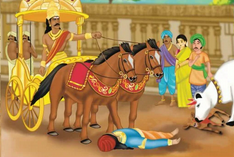
Long ago, a Chola prince was riding his chariot through a temple town when he accidentally ran over a calf, causing its death. The grieving mother cow went to the royal court seeking justice and rang a bell meant for citizens to present their grievances to the king. Hearing the bell, the king came out and learned of the incident. While his courtiers offered various solutions to absolve the prince of his sin, the king sought true justice for the cow, who had lost her calf.
The only just solution, he concluded, was to have the prince suffer the same fate as the calf. The prince would be laid on the ground and run over by the chariot wheel, leading to his death. However, the courtiers couldn’t bring themselves to carry out the order. Overcome with grief but committed to justice, the king himself took control of the chariot and ran the wheel over his only son, killing him.
As the story goes, the gods, disguised as the cow and calf, appeared before the king, revealing their true forms and blessing him for his unwavering sense of dharma—not only for his human subjects but also for animals. The king’s profound commitment to justice earned him the title “Manuneethi Chola.”
This Chola ruler, believed to have lived around 250 B.C. in southern India, upheld the principle that no one is above the law and all are equal before it. His legacy has inspired Indian judges in delivering fair and final verdicts in complex cases—a far cry from the modern judicial system’s current direction.
 மையின் சாரல்கள்
amazing description Parvati aunty❤️
LikeLike